
Cannabis Culture: Our Story – A Brief
Cannabis has been woven into human culture for so long that it’s impossible to capture its full story in a few pages. What follows is a brief, pointed overview—one that celebrates its legacy and looks honestly at how that legacy shapes life today.
Across generations and continents, cannabis has followed the same pattern—it moves with people. It shows up where there’s migration, art, music, or resistance. From ancient trade routes to the hidden corners of modern cities, it’s been a quiet passenger in the journeys of pilgrims, poets, dreamers, and wanderers. Whether in ritual, in rebellion, or in the search for a little more light in the day, it’s offered a small shift in perspective that can change everything.
This isn’t just a plant’s biography; it’s a social history, shaped by hands that cultivated it, laws that tried to erase it, and communities that kept it alive. It’s a story we’ve inherited—and one we now get to shape for ourselves.
Ancient Roots: Sacred, Medicinal, Social
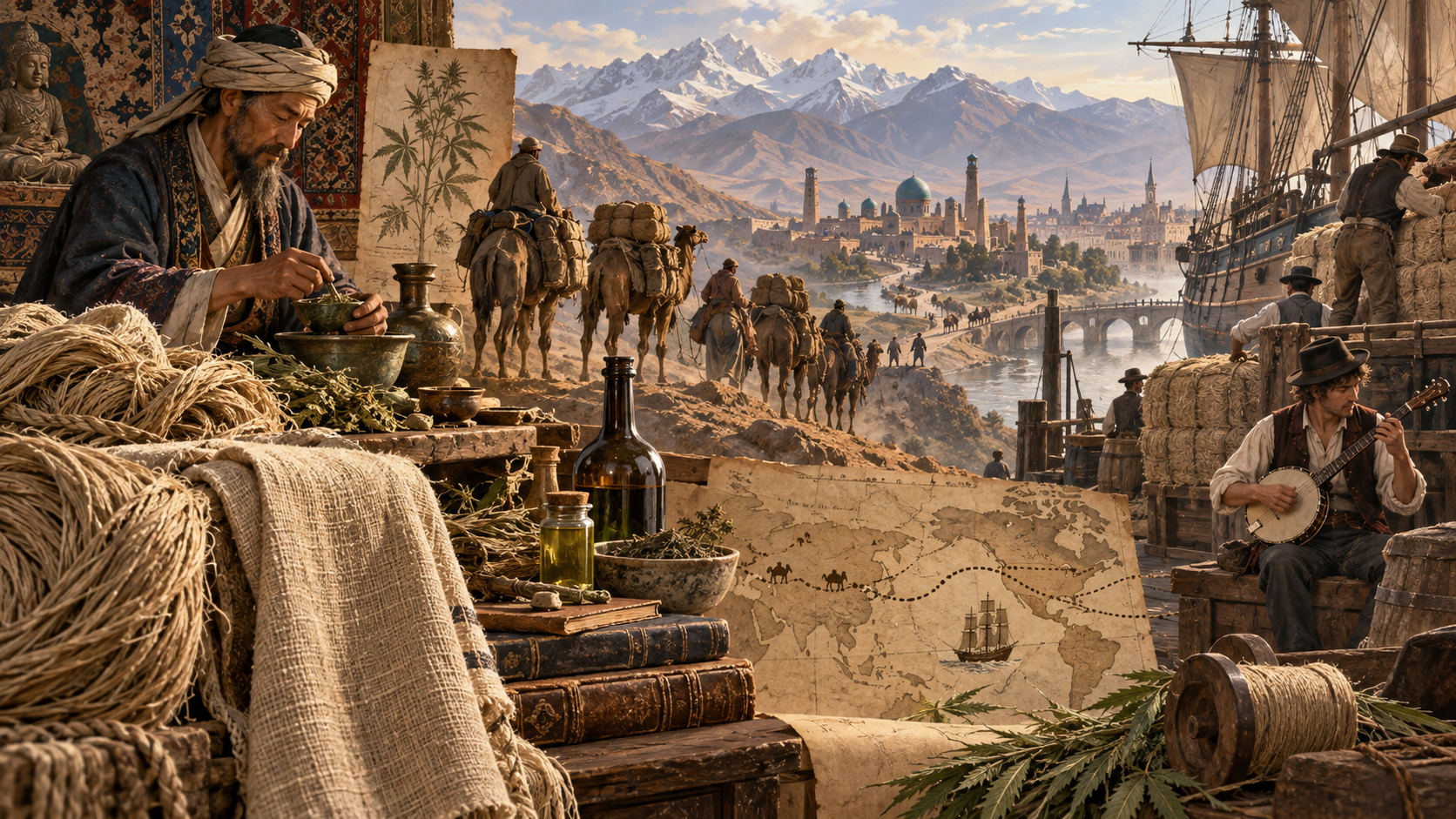
Most roads lead back to Central Asia, to the steppes near Mongolia and southern Siberia, where wild cannabis drew human attention for its strong fiber, nutritious seed, and its curious effect on the mind. That same fiber would one day make the ropes, sails, and even caulking that powered early seafaring vessels, carrying people, their cultures, and seeds — including cannabis — across oceans. Modern chemical anthropology, using tools like gas chromatography–mass spectrometry, has detected high-THC residue in ritual braziers — small open bowls used to burn plant material over hot coals — from the Jirzankal Cemetery in western China dating back about 2,500 years, clear evidence that cannabis was deliberately burned for intoxication.
Other burial finds in the region push ritual or medicinal use back over 4,000 years, though with less potent varieties.
Archaeology puts cannabis by ritual fires, smoke rising in ceremonies meant to lift the veil — whether that was seen as crossing into the spirit world or, in today’s language, confronting the hidden parts of the self we often keep in shadow. The very word shaman is Russian in origin, rooted in Siberia, where these early practitioners worked with cannabis in their rites. In India, bhang still makes its seasonal appearance to this day during Maha Shivaratri, celebrating Shiva’s appetite for transformation.
And cannabis moved beyond shrines. People brought it to feasts and festivals, folding it into social rites that included laughter, music, and yes, sometimes unabashed sensuality. Across the Atlantic, Indigenous communities in what’s now Mexico and the American Southwest worked with cannabis or cannabis-like ritual plants in healing and ceremony. In the Middle East, the storied Hashashin — an 11th-century sect active in Persia and Syria — became infamous for their skill in political assassination and their heavy use of hashish. Their name, often translated as “hash eaters,” fed into both legend and propaganda, painting them as mystics who blended cannabis intoxication with initiation rites and covert operations. In reality, much of what we “know” about them comes from hostile chroniclers, but the association between hashish, altered consciousness, and subversive action became one of the plant’s most enduring and misunderstood myths. The constant through all of this wasn’t scandal; it was human curiosity, directed at a plant that met us halfway.
Hemp, Medicine, and Music: Early North America to 1930
By the early 1600s, North America already knew “hemp,” but it wore two faces. Indigenous nations worked with native hemp (Apocynum cannabinum)—not botanically the same as Cannabis sativa, but prized for similar reasons. They spun its strong fibers into cordage, fishing nets, bowstrings, and textiles, and used plant preparations medicinally; in some communities it likely figured into ceremony. When European colonists arrived, they brought imported Cannabis sativa and bags of seed—hemp alongside flax and grain—and put it straight into the ground for rope, rigging, and sailcloth. In places like Virginia and Massachusetts, officials even required hemp cultivation; it was infrastructure in plant form.
Through the 1700s and 1800s, hemp was a workhorse crop across the colonies and the young republic. Enslaved Africans were forced to sow, harvest, and break hemp alongside tobacco and cotton; plantation records make that part plain. What’s murkier—because the paper trail is thin—is how often enslaved people used cannabis socially or medicinally. Oral history and scattered anecdotes suggest it happened; the ledgers, unsurprisingly, don’t say much.
By the 19th century, cannabis moved into the pharmacy. Bottles from Eli Lilly, Parke‑Davis and others sat behind the counter, prescribed for migraines, inflammation, insomnia, menstrual pain—standard fare. It had a quiet bedside manner and none of the moral panic that would come later.
By the late 1800s the Blues was taking shape—rising from field hollers into porch songs, juke joints, and rent parties. Cannabis moved quietly through these spaces in coded language and hand-to-hand rituals. As the Great Migration carried the blues north to Memphis, St. Louis, and Chicago, the plant traveled the same tracks, eventually finding its way into early jazz circles where “muggles” and other slang made it easier to talk about what you couldn’t name out loud.
By 1930, cannabis still looked like a working companion—field fiber, pharmacy tincture, a musician’s quiet tool. Then Washington handed a new badge to Harry Anslinger. His tenure backed with the support of William Randolph Hearst would flip the script, turning a familiar plant into a national menace in less than a decade.
Leave a Reply