
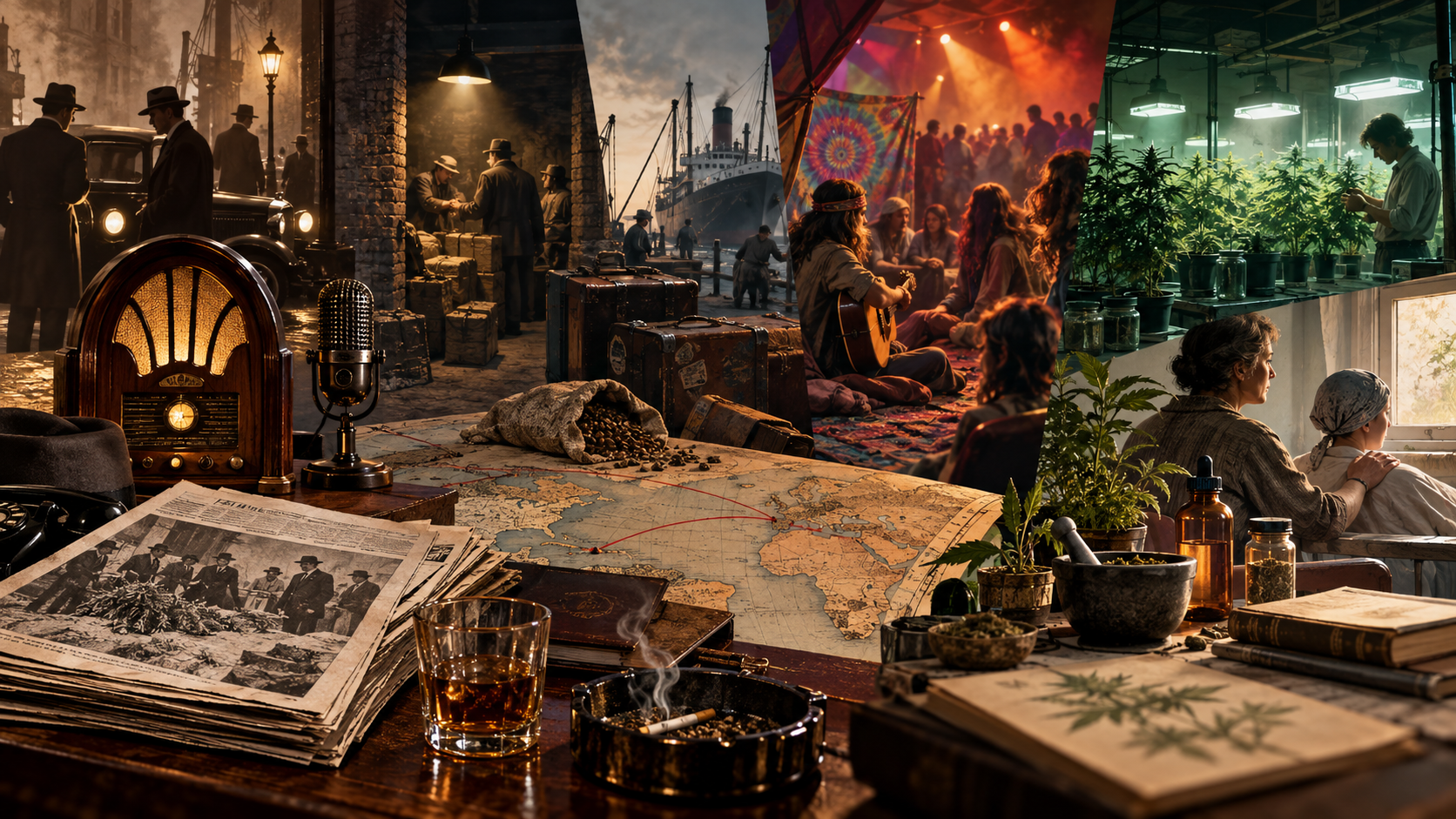
1930s–1960: Criminalization, Propaganda, and Survival Underground
Cannabis didn’t become illegal because of science, or danger, or even morality. It became illegal because it got in the way.
At the turn of the 20th century, hemp threatened timber and synthetic fiber interests. The pharmaceutical industry couldn’t patent a plant people were already growing in their backyards. And “marihuana”—as it was branded in racially charged campaigns—became an easy scapegoat in a time of cultural anxiety and media consolidation.
The loudest voice belonged to Harry Anslinger, the first commissioner of the Federal Bureau of Narcotics (predecessor to the DEA) and a devout racist who saw the plant as a tool to demonize Black jazz musicians and Mexican laborers. He weaponized fear through lurid, fabricated stories of cannabis‑fueled rape, madness, and violence—none of it true, all of it useful.
William Randolph Hearst, one of the largest newspaper owners in the United States, had both the means and the motive to amplify those lies. His nationwide chain made it easy to coordinate headlines—an early lesson in how media consolidation can steer public opinion. With timber and paper‑mill interests to protect, his front pages became a weapon. (The playbook should feel familiar today, when a handful of banks and conglomerates shape much of the mainstream narrative.)
DuPont, with patents on synthetic materials like nylon, lobbied to push hemp off the market. The Rockefeller Foundation and other pharmaceutical backers saw whole‑plant medicine as a threat to their profits.
It worked. In 1937, the Marihuana Tax Act effectively criminalized cannabis despite its long medical record.
The 1940s briefly complicated the story. During World War II, the U.S. government rolled out Hemp for Victory, urging farmers to grow hemp for rope, canvas, and uniforms when imported fibers were cut off. After the war, the door slammed shut again, returning both hemp and cannabis to prohibition.
The 1950s made penalties brutal. The Boggs Act (1951) and Narcotics Control Act (1956) set mandatory minimums—up to ten years—for simple possession, landing hardest on Black and Latino communities and cementing a racialized pattern of enforcement. Still, the culture refused to die; it just moved underground—into jazz clubs, back‑room card games, and quiet living rooms where joints and stories passed hand to hand.
In the 1950s, the plant’s path crossed with a different set of cultural insurgents: the Beat Generation. Writers like Allen Ginsberg and Jack Kerouac weren’t just chasing altered states—they were using cannabis as a pry bar to open language, to bend American prose into jazz‑like runs. Within Black, Latino, and working‑class communities, cannabis remained a sign of refusal—of holding space outside the dominant culture.
By 1960, the lines were drawn: the official story painted cannabis as a gateway to moral collapse, while the unofficial story saw it as a muse, a medicine, and a social glue. The stigma planted by Anslinger and Hearst still loomed, but the underground kept breathing, improvising, and waiting for the next shift.
The 1960s through 1980s: Seeds, Smugglers, and a Cultural Break
The ’60s didn’t just light up; it traveled. American backpacks came home stuffed with sativa-leaning seeds from Mexico, Jamaica, and South America—treasures like Acapulco Gold and Colombian Gold that matched the decade’s bright, talkative high. Cannabis moved through jam sessions, park gatherings, protests, and kitchen tables as part of a wider refusal of the status quo. Hippies embraced it as both a sacrament and a social glue, folding it into white counterculture alongside music, psychedelics, and anti-war politics.
Some travelers did more than sample. The Brotherhood of Eternal Love—the so-called “Hippie Mafia”—helped move genetics and know-how across borders, including resin-heavy lines from Afghanistan grown for hash. These passages widened the gene pool that modern breeding still draws from. Cannabis also found a place in Black liberation politics, with groups like the Black Panthers using it socially and symbolically—as a shared celebration, a marker of community, and in some cases, a quiet act of resistance.
The Vietnam War added its own layer to the story. Thousands of U.S. soldiers encountered cannabis in Southeast Asia—particularly in Vietnam, where cheap, potent weed and hashish were widespread. Many brought the habit home, helping to normalize its use among a generation that had already grown skeptical of government narratives.
The backlash sharpened, too. Timothy Leary’s famous mantra—“Turn on, tune in, drop out”—was weaponized by politicians as shorthand for everything threatening about the counterculture. Cannabis became an easy target, lumped together with anti-war protests, free love, and psychedelic exploration. Enforcement ramped up, and a familiar rhythm hardened into policy: Black and brown users bore the brunt of arrests and sentences, while white college kids often got a pass. This racialized pattern of policing wasn’t an accident—it was baked into drug war strategy and would persist for decades. Yet even under pressure, the culture adapted. Cannabis followed soldiers home from Vietnam, moved through jazz clubs and college dorms, and took root in new geographies—from West Coast communes to inner-city blocks. Every crackdown scattered the plant further, spreading not just seeds but a cultural identity that refused to disappear.
The 1970s: Schedule I, a Medical Reframing, and Early Genetics
The ’70s made two things clear at once: the state could be ruthless, and the plant could be generative. In 1970, President Nixon signed the Controlled Substances Act and parked cannabis in Schedule I—“no accepted medical use”—ignoring his own commission’s recommendation to decriminalize. That decision froze legitimate research for a generation and hardened the legal wall around the plant.
At the same time, Harvard psychiatrist Lester Grinspoon published Marijuana Reconsidered (1971), reframing cannabis as more than a vice. His change of heart came after watching it ease his young son’s chemotherapy nausea, turning him from skeptic to advocate. By telling that story in plain, persuasive language, he helped give “medical marijuana” its first serious public footing.
Meanwhile, breeders were quietly rewriting the plant’s future. Seed hunters came back from Afghanistan, Thailand, and Colombia with pockets full of possibility. These original wild varieties, known as landraces, are locally adapted cannabis strains that developed over centuries in isolation, shaped by their native climates and cultures. Afghan plants were short, fast, and resin-heavy—perfect for hash. Thai lines grew tall, with electric, long-lasting highs. Colombian golds stretched endlessly, dripping citrus and spice. Each landrace was a living blueprint, carrying traits that would fuel decades of hybridization.
In California during the 1970s, groups like Sacred Seeds—where Sam the Skunkman cut his teeth—began experimenting with these imported landraces. Sam and his circle famously stabilized Skunk #1, one of the first true hybrids, blending Colombian Gold, Afghani, and Acapulco Gold into a strain that was consistent, pungent, and easy to grow indoors. They also worked with Original Haze, built from Thai, Mexican, and Colombian lines, and laid the foundation for Durban Poison hybrids when African genetics reached the West Coast. At the same time, in the Pacific Northwest, breeders were experimenting with pure Afghani lines, selecting for compact plants and dense resin that could finish faster in colder climates. This work would eventually lead to Northern Lights in the following decade, but its roots were firmly planted in the 1970s. What began in basements, barns, and hidden gardens—messy, passionate, and largely undocumented—became the cornerstone of modern cannabis genetics.
Advocacy also started taking a formal shape. The National Organization for the Reform of Marijuana Laws (NORML) launched in 1970, giving reform-minded lawyers, activists, and everyday users a political home. Backed by grassroots donors and attorneys willing to test the law in court, NORML lobbied state legislatures and built the first national network pushing for cannabis reform. In 1974, High Times magazine hit the stands—equal parts counterculture chronicle, strain guide, and political soapbox—quickly becoming the glossy heartbeat of cannabis culture.
Within just a few years, their efforts paid off. Between 1973 and 1978, 11 states decriminalized possession of small amounts of cannabis, usually defined as one ounce (28 grams) or less. Oregon led in 1973, followed by Alaska, California, Colorado, Maine, Minnesota, Ohio, and Mississippi in 1975; New York and North Carolina in 1977; and Nebraska in 1978. In these states, simple possession was reduced to a civil fine, often no harsher than a traffic ticket. Even President Jimmy Carter, elected in 1976, endorsed decriminalization, telling Congress in 1977 that penalties for cannabis “should not be more damaging to an individual than the use of the drug itself.” That alignment between NORML’s grassroots pressure and Carter’s brief window of political support marked the high-water point of the 1970s reform wave—before the backlash of the 1980s reset the debate.
The 1980s: Brick Weed, Crack, Hypocrisy, Indoor Innovation—and the First Medical Fight
The decade opened with a comedown. Low-grade “brick weed” from Mexico flooded the U.S.—compressed for smuggling, stripped of fragrance, riddled with seeds and stems. At the same time, the crack epidemic tore through American cities just as national cannabis droughts hit—dry spells that sent prices soaring and pushed some users toward whatever was available. In too many neighborhoods, harder drugs suddenly became cheaper and easier to get than cannabis, warping markets and deepening the social damage.
The Reagan White House swung a moral sledgehammer. “Just Say No” painted cannabis with the same brush as crack and heroin. D.A.R.E. marched into classrooms, and in practice it often encouraged kids to inform on their own families for a joint in the house. Mandatory minimums, asset forfeiture, and SWAT-style raids militarized drug enforcement; helicopters thumped over rural grow regions, and police could seize homes, cash, and cars on suspicion alone.
Behind the podium, the hypocrisy was staggering. Investigations and later inquiries tied elements of U.S. agencies—including the DEA/CIA nexus—to international cocaine trafficking and covert foreign operations. While Washington preached zero tolerance, parts of the apparatus were entangled with the very trade it claimed to be fighting.
Enforcement landed hardest where it always had: in Black and Latino communities. Crack vs. powder sentencing disparities locked in a racial double standard, and corruption flared—most notoriously in New York’s 75th Precinct, where officers like Michael Dowd slid from busting dealers to protecting them.
Growers adapted to survive. To outrun helicopters and informants, they moved indoors, pioneering the environmental controls that now define modern cultivation: HID lamps, timers, hydro systems, tight ventilation, dialed nutrients. What began as evasion became innovation—year-round harvests, tighter genetics, and a new craft under pressure.
In the middle of the crackdown, a crisis changed the stakes. The AIDS epidemic devastated cities like San Francisco and New York, and patients found cannabis uniquely effective for wasting syndrome, nausea, and pain when legal meds failed. Activists stepped in. Dennis Peron, a Vietnam vet whose partner died of AIDS, pushed safe-access politics into the open. “Brownie Mary” Rathbun baked and delivered medicated brownies to patients at San Francisco General, risking arrest to provide relief. Underground compassion clubs took shape—early prototypes of the medical dispensaries to come—and the moral argument for cannabis as medicine became impossible to ignore.
Meanwhile, abroad, cannabis found a public stage. In 1988, High Times launched the Cannabis Cup in Amsterdam, creating a global meeting point where breeders and growers could compare work, swap genetics, and celebrate openly—if only offshore. NORML kept fighting through the headwinds at home, holding the reform line in courts and legislatures.
By the decade’s end, the plant had weathered droughts, raids, and relentless propaganda—while artists like Cypress Hill made cannabis an open motif in hip-hop, pushing the conversation closer to the daylight it had long been denied.
Leave a Reply