
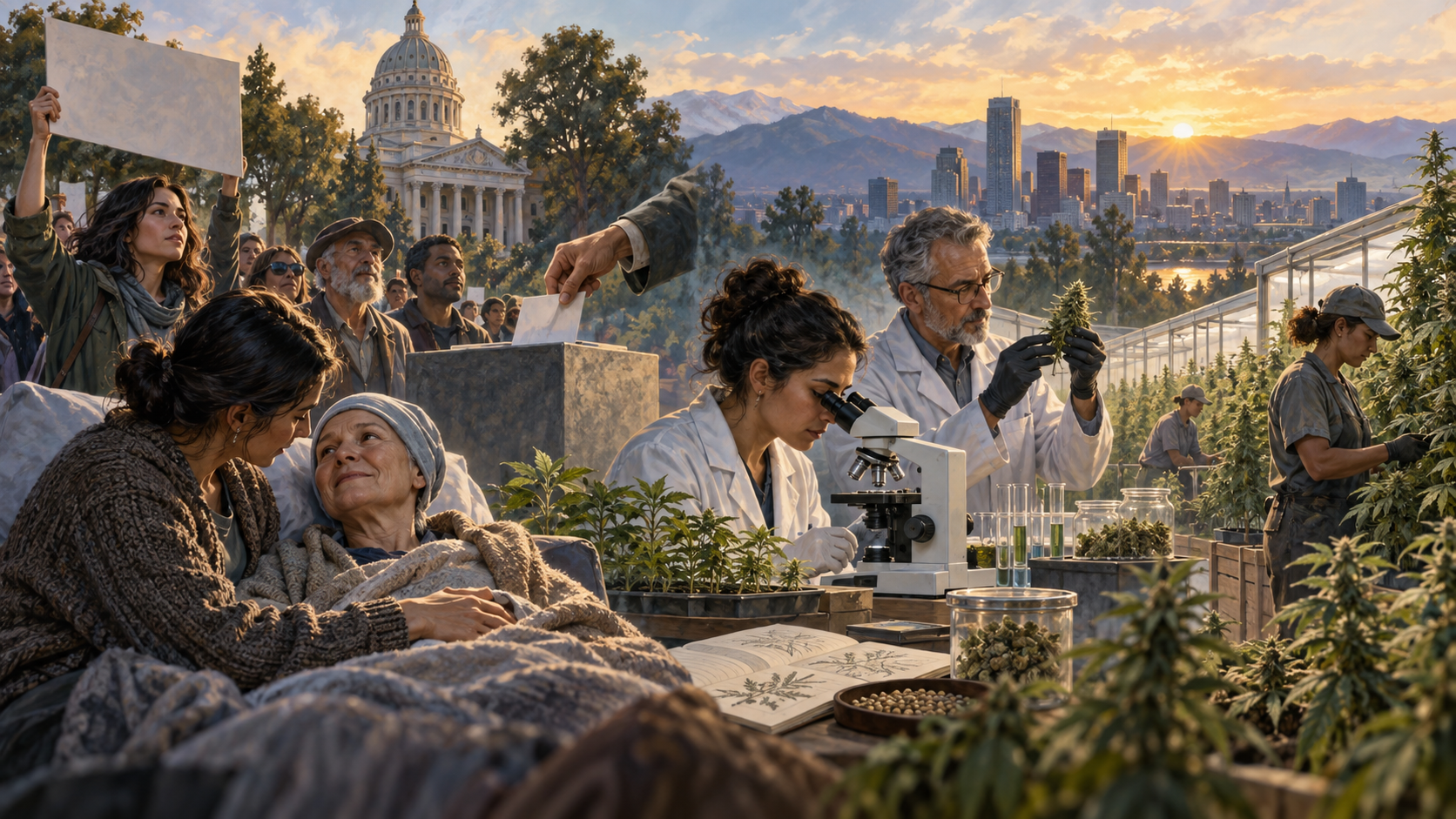
The 1990s: Proposition 215 and a Movement Hardens
The 1990s was the decade when cannabis finally broke out of the shadows and began pushing into the mainstream. Medical cannabis became the rallying cry, even as much of the weed being smoked was still the compressed “beasters” from Canada or the outdoor buds moving through California and Dead tour parking lots. The imported bud of the 1980s had mostly come from Mexico, but now the supply lines had shifted north. But the biggest shift came at the ballot box. In 1996, the people of California forced history’s hand with Proposition 215—the first medical cannabis law in the nation, passed by citizen initiative. That spark spread quickly: by the end of the decade Oregon, Alaska, Washington, Nevada, and Maine had all legalized medical use, each one making it harder to deny the plant’s therapeutic value. These were victories won by citizens, not politicians. Activists gave the movement a spine. Jack Herer, with The Emperor Wears No Clothes, argued relentlessly for hemp’s ecological and industrial promise and for cannabis’s medical dignity.
NORML pressed on in courtrooms and legislatures. In Massachusetts, attorneys like Steven Epstein worked towards decriminalization and patient rights. In California, Debby Goldsberry co-founded the Cannabis Action Network (CAN), taking education on the road with “hemp tours.” Paul Armentano helped keep the research and policy arguments sharp. In Maine, voters passed their own medical cannabis law in 1999. The upshot: medical use gained legitimacy, and the culture learned to speak in studies as well as stories.
The culture wasn’t just in politics—it was in the streets. Annual gatherings like Seattle Hempfest, the Boston Freedom Rally, drew thousands, fusing music, activism, and open cannabis use into public celebrations that doubled as acts of defiance. Mainstream media caught the signal. Films like Friday (1995) and Half Baked (1998) turned cannabis into a familiar character rather than a cartoon villain. On the cultivation side, the strain canon grew: Northern Lights, OG Kush, White Widow—hybrids that set new expectations for aroma, potency, and uniformity.
But the ’90s were also a time of harsh federal pushback. Bill Clinton—famously suggesting once that he tried cannabis but “didn’t inhale” kept cannabis in Schedule I, oversaw aggressive DEA raids on medical growers, and signed the 1998 Higher Education Act provision that stripped student aid from anyone convicted—even for as little as a joint. Meanwhile, Joe Biden, who had coined the idea of a federal “drug czar” and spearheaded the Violent Crime Control and Law Enforcement Act of 1994, pushed the “Three Strikes” law, which made a third felony—often a trivial drug offense—punishable by life in prison without parole. He also went on to sponsor the RAVE Act (originally the “Reducing Americans’ Vulnerability to Ecstasy Act”), expanding the crack-house statute to cover raves and festivals, effectively criminalizing venues for the actions of partygoers. That didn’t just devastate Black communities already targeted by mandatory minimums—it also gutted rave culture in the United States, pushing it deeper underground alongside cannabis. For me, the era wasn’t abstract: my car was illegally searched in the ’90s, and I nearly lost my college funding and housing over a single gram of weed. The charge was thrown out thanks to the illegal search, but plenty of others weren’t so lucky. By decade’s end, cannabis arrests had ballooned, with Black Americans still being targeted at four times the rate of whites despite equal usage..
By the mid-1990s, another shift was reshaping the market. The cartels that once flooded U.S. streets with petroleum-smelling Mexican brick weed packed with seeds were being replaced by mass-produced indoor cannabis from Canada. With higher THC levels, cleaner noses, and seedless bud, the era of brick was over. In the States, growers were moving in the opposite direction of the cartels—away from fields of schwag and toward carefully cultivated “kind bud” that became a cultural signifier in itself. Strains like Northern Lights, Skunk #1, Haze crosses, and early Kush lines were gaining traction in college towns, jam-band parking lots, and medical circles alike. On Grateful Dead tour, entire micro-economies sprang up around parking lots where glass, psychedelics, and sticky green bags of “kind” changed hands—cultural exchanges that helped spread both the genetics and the ethos of a new cannabis underground.
Meanwhile, north of the border, a different kind of cannabis empire was thriving. In British Columbia, the Hells Angels had firm control over trafficking networks—especially the vacuum-sealed “beasters” that were shipped south in bulk to the U.S. In Quebec, an outlaw gang called the Rock Machine challenged that monopoly. Their refusal to bow down ignited the Quebec Biker War (1994–2002), a violent struggle where cannabis smuggling was the hidden prize behind assassinations, bombings, and over 160 deaths. In the end, the Hells Angels emerged stronger—their grip on Canadian cannabis smuggling into the United States cemented—even as American growers, breeders, and activists were sowing the ideological and legal groundwork for a peaceful redefinition of our relationship with the plant.
By 1999, the plant’s legal status was fractured: embraced in pockets, criminalized in others, and still the focus of a widening culture war. But the groundwork had been laid for the medical wave of the 2000s.
The 2000s: Fourteen Medical States, New Tools, Changing Culture
By the 2000s, medical laws reached fourteen states—Alaska, Nevada, Oregon, Washington, Hawaii, Colorado, Montana, Vermont, Rhode Island, New Mexico, Michigan, and more—laying the groundwork for regulated access and a common language of compliance.
A new wave of strains took star turns. Blue Dream became the everyday workhorse; Trainwreck and AK-47 delivered amped, upbeat experiences; Bubba Kush and Granddaddy Purple (from Ken Estes) deepened the sedative, grape-tinged end of the spectrum. Breeders also popularized autoflowers like Lowryder, developed by the Joint Doctor, shrinking the barrier to entry for small spaces and short seasons.
Growers refined techniques. Light deprivation (“light dep”) let outdoor farmers pull extra harvests with tarps and timing. Extract enthusiasts pushed toward dabs, riding a steep learning curve that occasionally proved—literally—explosive for the DIY crowd.
9/11 reshaped border security overnight. For years, biker networks had funneled “beasters” from Canada into the U.S., flooding East Coast markets with mid-grade weed. But after the attacks, those smuggling routes collapsed almost instantly. The new security regime slammed the northern border shut, choking off a supply chain that had seemed unstoppable. Demand, however, never wavered. A vacuum opened—and American growers rushed to fill it.
On the East Coast, basements, barns, and backwoods fields scaled up almost overnight. Hydroponic setups boomed, and with them came the rise of regional “exotics”—Sour Diesel, Chem Dog, Strawberry Cough, NYC Piff—strains that set a new quality bar and rewrote what buyers expected.
Politics stayed messy. Even as states wrote medical frameworks, the DEA kept raiding dispensaries, citing federal supremacy. Bush’s administration dug in hard, and fear ran through the culture. When Obama took office, his early signals suggested a softer line, but raids still happened. The contradiction defined the era: state-sanctioned “legal” programs existed, but under constant threat from federal power. That tension shaped how businesses operated—cautious, cash-based, semi-underground—while activists doubled down on pushing reform further.
Corporations took notice. Scotts Miracle-Gro moved aggressively, acquiring General Hydroponics, Sunlight Supply—the largest cannabis grow equipment supplier in the U.S.—along with Botanicare and Gavita Lighting, stitching together a supply chain. Their proximity to Bayer/Monsanto set off alarms among independents who worry that seeds, lights, and nutrients might consolidate under a few logos. The fear isn’t abstract: the more centralized the inputs, the harder it gets for small growers to keep margins and autonomy.
The 2010s: Boom, Bust, and the Birth of Modern Cannabis
The 2010s were a hinge point for cannabis. In 2012, Colorado and Washington became the first U.S. states to legalize recreational cannabis—adult use—and the floodgates opened. By the end of the decade, more than 30 states had medical programs, and a growing handful had gone fully legal. Arrests for non-violent cannabis offenses dropped by more than 70% in many of those states, easing (though not erasing) the criminal-justice load. For the first time in generations, cannabis wasn’t just tolerated in shadows—it was being celebrated in public.
But legalization also collided with federal reality. Cannabis remained a Schedule I drug, and the federal tax code’s Section 280E stayed in place. For retailers, that meant no normal deductions for rent, payroll, or marketing. Effective tax rates often soared to 60% or higher. Growers fared a little better—they could still deduct most direct cultivation expenses as cost of goods sold—but dispensaries were routinely bled dry by the tax line.
On top of that, politics were anything but stable. Barack Obama’s administration had issued the Cole Memo in 2013, which essentially told federal prosecutors to back off state-legal markets. That gave entrepreneurs enough confidence to start building businesses in the open. But when Donald Trump took office in 2017, his Attorney General Jeff Sessions tore up the memo and threatened crackdowns. The industry braced for raids that never fully materialized, but the whiplash was real: one year cannabis felt like the future, the next year it felt like a target again.
Meanwhile, the Green Rush exploded—and it was chaotic. Laws were vague, enforcement uneven, and a gray market flourished. Storefronts popped up everywhere, many without proper licenses but still plastered with green crosses and neon “OPEN” signs. People were openly advertising weed on Craigslist, Facebook, and Instagram, posting photo menus that looked more like restaurant specials than contraband. Delivery services promised “fast, discreet” drops with slick branding. But none of it was easy—success still meant long hours, organization, and serious hustle. It was a gold rush mindset: thousands dove in, some made quick money, and others—savvy enough to spot the regulatory wave ahead—got rich and quietly cashed out.
Legalization opened doors for patients and adult use but also for monopolies. In California, Berkeley Patients Group—under Tim Schick—wrapped itself in activist language while lobbying for restrictive rules in places like Maine that locked out small growers. Florida took the corruption further. Lawmakers engineered a medical program with sky-high barriers to entry, carving out licenses for politically connected “legacy farms.” At the center was Trulieve, built by Kim Rivers and boosted by her husband J.T. Burnette’s political network, alongside families like the Simpsons, whose nursery ties shaped the law itself. With vertical integration requirements and limited licenses, Florida’s rollout became a cartel, enriching insiders while patients and small farmers were boxed out. Lawsuits and activism later chipped away at the system, but the damage was done: access and ownership flowed upward, not outward.
Wall Street poured in early and lost fast. Constellation Brands—maker of Corona beer, Modelo Especial, and others—stunned the market by dropping nearly $4 billion USD (C$5B) into Canopy Growth, briefly becoming its majority shareholder. Analysts hailed it as proof cannabis had gone mainstream, and suddenly every big fund and retail trader wanted in. MedMen, Aurora, Tilray, and others ballooned with billion-dollar valuations, trading on hype more than harvests. But cannabis doesn’t scale like software. You can’t spreadsheet your way past agricultural risk, state-by-state rules, and a consumer base that can smell bad weed—or a tone-deaf brand—a mile away.
By the late 2010s, the cracks showed. Canopy bled cash and cycled CEOs. MedMen became a cautionary tale of excess, accused of reckless spending on luxury offices and private jets while stores ran short on product. Aurora’s grow-to-the-moon expansion plan collapsed under debt. Investors who thought they were buying into the “next alcohol industry” watched stock prices crater, wiping out billions in paper wealth.
The lesson was blunt: corporate money could accelerate growth, but it couldn’t shortcut culture, compliance, or craft.
Technology sprinted forward. LEDs matured from novelty to standard, offering efficiency, spectrum control, and cooler canopies. Extraction labs figured out how to coax diamonds and sauce from resin, and vape pens broke cannabis into the mainstream consumer market. Breeding crowned hybrids that defined the decade: Girl Scout Cookies (GSC) from OG Kush × Durban Poison, Gorilla Glue #4 (GG4) from Sour Dubb × Chocolate Diesel × Chem’s Sister, and Wedding Cake from GSC × Cherry Pie. These strains set the tone for the modern era—dense, resin-rich, loud, and reliable enough for scaling.
Looking back, the 2010s were the industry’s adolescence. Legalization brought legitimacy, Wall Street brought capital, technology brought innovation, and breeders brought the flavors and potency that defined a generation. But the decade also left behind bruises: brutal taxes, failed corporate experiments, and a chaotic rush that rewarded hustlers as often as it broke them. Cannabis had entered the light, but it was still finding its balance.
The 2020s: From Green Rush Crash to Industry Reset
The 2020s didn’t roll like the pack’s hype—they crashed. After the boom, legal markets buckled under oversupply, taxes, and unrealistic expectations. Colorado dispensary revenue slumped from $2.2 billion in 2020 to $1.5 billion by 2023. California lost tens of billions to dead licenses, while over 10,800 cannabis licenses now sit inactive—outnumbering active ones for the first time in 2025.
The pandemic gave cannabis a strange double-edged spotlight. In 2020, governors from California to Massachusetts declared dispensaries and cultivation facilities “essential businesses,” keeping them open while restaurants, gyms, and bars went dark. Sales spiked—people stocked flower and edibles the way they stocked toilet paper and hand sanitizer. For a moment, it looked like cannabis had finally been legitimized as part of everyday life.
But when it came to federal relief, the mask slipped. Cannabis businesses were locked out of the PPP loan program and other COVID safety nets, even as they were forced to operate under pandemic risk. When wildfires swept the West Coast that same year, FEMA stepped in for traditional farms but not cannabis operations. Growers who’d lost greenhouses and crops to fire and smoke got no federal help—reminders that “essential” didn’t mean equal. The contrast sharpened the sense that legalization was still provisional, and that the rules bent hardest against the people actually growing the plant.
This decade also opened with rules and readouts. Most legal states now run METRC, a seed-to-sale barcode regime that tracks each plant like a pallet of microchips. Labs measure THC, THCA, CBD, terpenes using GC/MS and HPLC, giving us—for the first time—a shared vocabulary for what we smell, taste, and feel. Congress even loosened its grip: the Marijuana Research and Expansion Act of 2022 widened the lane for scientists who’d been boxed out by Schedule I. Access doesn’t equal consensus, but it helps.
Markets, meanwhile, did what markets do: they flooded. In California, Oregon, and Colorado, licensing and capacity outran demand. I watched Oregon prices sink to $250 a pound, middlemen stuck with warehouses of unsold flower. Some small growers walked away. Others doubled down and won—because consistent, high-quality flower still commands a premium ($35–$50+ for an eighth). The best operators learned to align craft with lean systems, pulling 60%+ returns on time and money while neighbors folded.
The fall hit hardest on the backbone of the industry: trim culture and mom-and-pop shops that once defined the Emerald Triangle. Seasonal “trimigrants” faded as the work dried up, leaving abandoned barns and debt-strapped farms behind. Growers who once hired crews now packed boxes and ran tractors themselves just to survive.
With the coast crumbling, the market shifted east—along with the dream. But the heart had failed. Retailers and supersized operators stumbled, too. Michigan’s TerrAscend abruptly shuttered 20 storefronts and processing sites, laying off 230+ workers. Consolidation tightened its grip as Trulieve, Curaleaf, and Cresco inched toward monopoly.
The 2020s exposed how hard consistent, high-quality cannabis is to scale. Once-celebrated operators bled cash, shuttered sites, and lost billions. Canopy Growth announced sweeping layoffs and asset sales alongside $425–$525 million in restructuring charges in 2023, a stark rewind from its go-go expansion years. Aurora Cannabis closed multiple facilities and cut staff as early as 2020 to staunch losses. In the U.S., the headline megamerger that was supposed to create a Coke-sized cannabis brand—Cresco Labs × Columbia Care—collapsed in 2023, a symbol of financing gridlock and regulatory choke points. MedMen—once valued near $3B—entered bankruptcy/receivership in 2024 with about $411M in liabilities. Wall Street’s cannabis darlings became cautionary tales, and the “green rush” collapsed into a hard market correction.
Adding to the frustration, corporations leaned heavily on the promise of federal legalization or rescheduling—banking reform, tax relief, and interstate commerce were always “just around the corner.” But Washington never delivered. Hopes of 280E repeal, SAFE Banking, or full descheduling fizzled, leaving operators with the same tax burdens, fractured markets, and limited investor confidence. The result was a brutal decade of contraction where scale was punished, and only lean, quality-driven operators could survive.
Consumer tastes tilted stronger, reflecting a market that still hasn’t matured—high THC numbers and sticker price drive the shelves more than nuance or terroir. Headlines drooled over Godfather OG testing above 35% THC, while hybrids like Runtz (Zkittlez × Gelato), Gelato (Sunset Sherbet × Thin Mint GSC), and Wedding Cake stayed hot for their terpene aesthetics and reliable effects. Concentrates surged—diamonds and sauce (crystalline THCA suspended in terpene-rich extract) and rosin (a solventless concentrate pressed from flower or hash using only heat and pressure) became the cannabis world’s version of luxury tech brands, a connoisseur tier with lab-bench standards. And yet it’s absurd: every single package already carries a METRC tag, meaning regulators can track each gram from seed to sale, but retailers still reduce products to a THC % on the label, as if that single number defines quality. For everyone else, edibles, vapes, and infused beverages carved deeper into flower’s market share, while hemp-derived delta-8 and its cousins blurred the legal lines at gas stations nationwide.
If there’s a moral here, it’s simple: for individuals, it has never been easier to grow your own cannabis and enjoy the plant on your own terms. But for businesses, the era of easy wins is over. Success now belongs to those who innovate—building lean systems, delivering consistent quality, and treating cultivation, marketing, and brand awareness with the discipline of any world-class industry.
Empowering a New Generation of Growers
Cannabis is ancient; the industry is young. That tension is the opportunity. This plant still represents independence, neighborhood economies, and a stubborn insistence on doing things right. The future belongs not only to small, serious cultivators who run clean rooms and build living soils, but also to hobbyists who grow a few plants with care and pride. Whether you’re tracking data and airflow or just learning to read your leaves, the common ground is intention and respect for the plant.
This book hands you the levers: cultural context, week-by-week practices, SOPs, and business strategy. Cannabis has always been a story of resilience and reinvention. You’re part of that lineage now—whether your garden is a closet, a backyard, or a warehouse. Grow with purpose, hold the line on quality, and add your chapter to a living history that prizes authenticity over hype. The next turn of the story begins wherever you hang your lights or turn your beds.
Leave a Reply